For general information about the program, information for the current year, and documentation of results from past years, see the tabs and pull-down menus on this webpage. For specific questions, do not hesitate to send e-mail to our mailbox at cybertraining@umbc.edu.
Jianwu Wang, Ph.D. (jianwu _at_ umbc.edu) [PI, Professor, Data Science]

Dr. Jianwu Wang is a Professor of Data Science in the Department of Information Systems. He leads the Big Data Analytics Lab at UMBC and co-leads the NSF HDR Institute for Harnessing Data and Model Revolution in the Polar Regions (iHARP). He is also an affiliate faculty at the Department of Computer Science and Electrical Engineering and the Joint Center for Earth Systems Technology (JCET), UMBC. His research interests include Big Data Analytics, Scientific Workflow, Distributed Computing, Service Oriented Computing. He has published 180+ papers with more than 5000 citations (h-index: 30). He is/was associate editor or editorial board member of four international journals, conference organization committee member of eight conferences and co-chair of eight related workshops. He is also program committee member for over 40 conferences/workshops, and reviewer of over 15 journals or books. Since joining UMBC in 2015, he has received multiple external grants as PI funded by NSF, NASA, DOE, State of Maryland, and Industry. He is also an NSF CAREER awardee. He was PI of the NSF initiative CyberTraining: Big Data + HPC + Atmospheric Physics at UMBC. His current research interests include Big Data Analytics, Causal Artificial Intelligence, Earth Informatics and Distributed Computing with application focuses on Earth, climate and manufacturing.
Pengwang Zhai, Ph.D. (pwzhai_at_umbc.edu), [Co-PI, Professor, Atmospheric Physics]
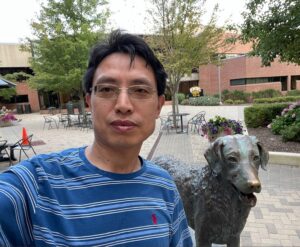
Dr. Pengwang Zhai is a Professor of Physics at the University of Maryland, Baltimore County (UMBC). His research focuses on light scattering by irregular particles, polarized radiative transfer in coupled atmosphere–ocean systems, and remote sensing of aerosols and ocean color. A major emphasis of his work is the development of accurate and efficient methods for solving the vector radiative transfer equation and modeling multiple scattering in complex, turbid environments. He applies light-scattering and radiative-transfer theory to develop advanced remote sensing algorithms that use multi-angle, multi-wavelength, and polarimetric observations from satellite and airborne sensors. His research also includes understanding the optical properties of aquatic particles, including phytoplankton, and developing methods to characterize them in natural waters. He leads the Atmospheric and Ocean Optics Group at UMBC and is a Science Team member of NASA’s Plankton, Aerosol, Cloud, and ocean Ecosystem mission. Dr. Zhai joined the UMBC Department of Physics in 2014. Prior to joining UMBC, he was a postdoctoral research associate in the Department of Physics at Texas A&M University, a NASA Postdoctoral Program Fellow at NASA Langley Research Center, and a senior research scientist at Science Systems & Applications, Inc. (SSAI).
Roy Prouty (proutyr1_at_umbc.edu), [Co-PI, Assistant Director for Research Computing, UMBC DoIT]

Roy Prouty is the first Assistant Director for Research Computing within the Division of Information Technology (DoIT) at UMBC as well as the Director of the Observatory at UMBC. Roy has a M.S. in Atmospheric Physics and a M.S. in Computer Science. As an CI Professional, Roy has significant high-performance computing experience as lead system architect and strategy lead for three on-premises computing clusters supporting campus-wide research computing endeavors at UMBC. Roy has led and facilitated many HPC trainings at UMBC, has taught university observational astronomy courses, and has led the development and delivery of geoscience-focused HPC workshops at UMBC and UMCES.
Additional Mentors: Besides the above lead instructors/mentors, additional mentors will be invited from the Center for Scalable Data and Computational Science (ScaleS) to guide research projects.